
I Application
1. The analytical methods used in this instrument comply with the requirements of standards such as GB/T 5750.4-2006 and GB 11896-89.
2. This instrument can be used for the analysis of various color titration parameters in water quality, including total hardness, chloride ions, and total alkalinity.
II Technical Requirements
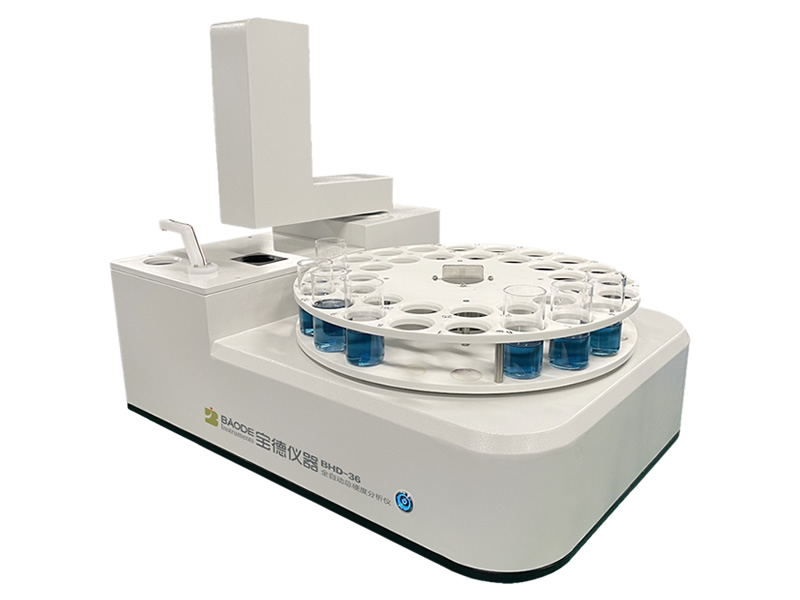
★1. Employs polar coordinate robotic arm technology, coupled with a disc-type sample tray, to grasp and release samples accurately at different positions; the sample tray is made of polypropylene material, resistant to acid and alkali corrosion.
★2. Equipped with "anti-drop" function; if no sample cup is available during the robotic gripper's grasping process, it skips that position, grasps subsequent samples, and triggers an alarm.
★3. A high-sensitivity detection unit ( detection frequency: sensor response time ≤ 1ms) can quickly and accurately determine the titration endpoint. The software acquires and processes data automatically, and the test interface displays the detection results directly .
★4. The titration process follows the manual titration method strictly, employing RGB color sensing technology to simulate human eye color recognition. The instrument is suitable for analyzing various color titration items such as total hardness, water chloride, and total alkalinity. During titration, the instrument displays and records sensor data in real time. It does not use voltage, current, or photometric colorimetry and does not accept camera-based image recognition. (Provide detector photos)
5. After placing the sample to be tested in the sample position, the instrument can complete the sample processing automatically without manual intervention. The instrument determines the titration endpoint automatically and displays the test data in real time on the workstation system;
6. A 150 mL high-transparency quartz sample cup is used to ensure good light transmittance and excellent resistance to contamination and corrosion;
★7. The reagent addition unit includes an outlet pipeline and an inlet pipeline, with a total of 5 dispensing pumps, ensuring that each reagent has an independent pipeline to prevent cross-flow and contamination;
8. The detection unit includes a detection position (with a stirrer) and a detection system. The detection position is located on the left side of the disc-shaped sample tray, at a distance of ≤140mm, and the stirring speed is flexibly adjustable;
▲9. To meet ventilation requirements and ensure the safety of laboratory personnel, smaller instruments are preferred. The instrument's reference dimensions (length * width * height) should be ≤770mm * 580mm * 720mm (please provide a copy of the instrument's overall structural diagram and actual dimensions);
10. WLAN network interface should be used to connect the instrument to the workstation, ensuring high and stable transmission speed. Other connection methods are not accepted.
11. The workstation automatic control system controls all workstation functions. The software runs on Windows and has a user-friendly interface. The software provides optimized operating conditions according to functions, and users can complete the entire sample addition and testing process automatically by selecting options.
★12. Instrument Technical Specifications
Water Chloride Ion Method
1) Method Principle: Silver nitrate titration
2) Minimum Detection Concentration: 25 mg/L
3) Precision (RSD): ≤3%
4) Accuracy: Within the range specified for quality control samples
5) Sample Testing Frequency: 4 min/sample
Total Hardness Method
1) Method Principle: Disodium EDTA titration
2) Minimum Detection Concentration: 1 mg/L
3) Precision (RSD): ≤2%
4) Accuracy: Within the range specified for quality control samples
5) Sample Testing Frequency: 3 min/sample
Water Total Alkalinity Method
1) Method Principle: Volumetric method
2) Minimum Detection Concentration: 4 mg/L
3) Precision (RSD): ≤2%
4) Accuracy: Within the range specified for quality control samples
5) Sample Testing Frequency: 3 min/sample
Salt Iodine Method
1) Method Principle: Sodium thiosulfate titration
2) Detection Range: 0-200 mg/kg
3) Precision (RSD): ≤2%
4) Accuracy: ±2 mg/kg
5) Sample Detection Frequency: 4 min/sample
Methods for Calcium, Magnesium, and Sulfate in Salt Production
1) Method Principle: Disodium ethylenediaminetetraacetate titration
2) Precision (RSD): ≤2%
3) Accuracy: Within the range specified for quality control samples
4) Sample Testing Frequency: 10 min/group (each group includes three indicators for one type of sample)
Acid Value Determination in Petroleum
1) Method Principle: Potassium hydroxide-ethanol standard solution titration method
2) Precision (RSD): ≤2%
3) Sample Testing Frequency: 4 min/sample
III Instrument Configuration Requirements
Item No. | Name | Quantity |
1 | Automatic Titrator | 1unit |
2 | Workstation Software | 1set |
3 | Accessory Kit | 1set |
4 | Instruction Manual | 1set |
Last:No Data
Next:No Data